The App Store’s Brutal Truth: Why Startups Can’t Afford Average Apps

The app industry represents a significant battlefield for businesses fighting for consumer attention and loyalty. With millions of apps available across various platforms, the competition is fierce. However, not all apps are created equal, and the value derived from an app can vary dramatically based on its market performance. Here we explore why aiming for mediocrity in the app development space rarely pays off and how investing in native app development for platforms like iOS and Android can be crucial for crafting a top-performing app.
Let us explore all the benefits your company can unlock by embracing mobile apps. We will break it down using the App ROI Framework (explained below) and illustrate its application with real-world examples. This framework is your roadmap to understanding the full spectrum of advantages that come with having a mobile app and how to maximize them effectively. Whether you're a C-suite executive or a product owner, mastering these tactics will position your company as a leader in harnessing the power of mobile apps.
Top apps dominate the market: Understanding the dynamics of app store polarization
The app market is highly polarized, with most of the benefits going to the top apps. Various studies and market analyses suggest that the top three to five apps in any given category capture the majority of the market's revenue and user engagement.
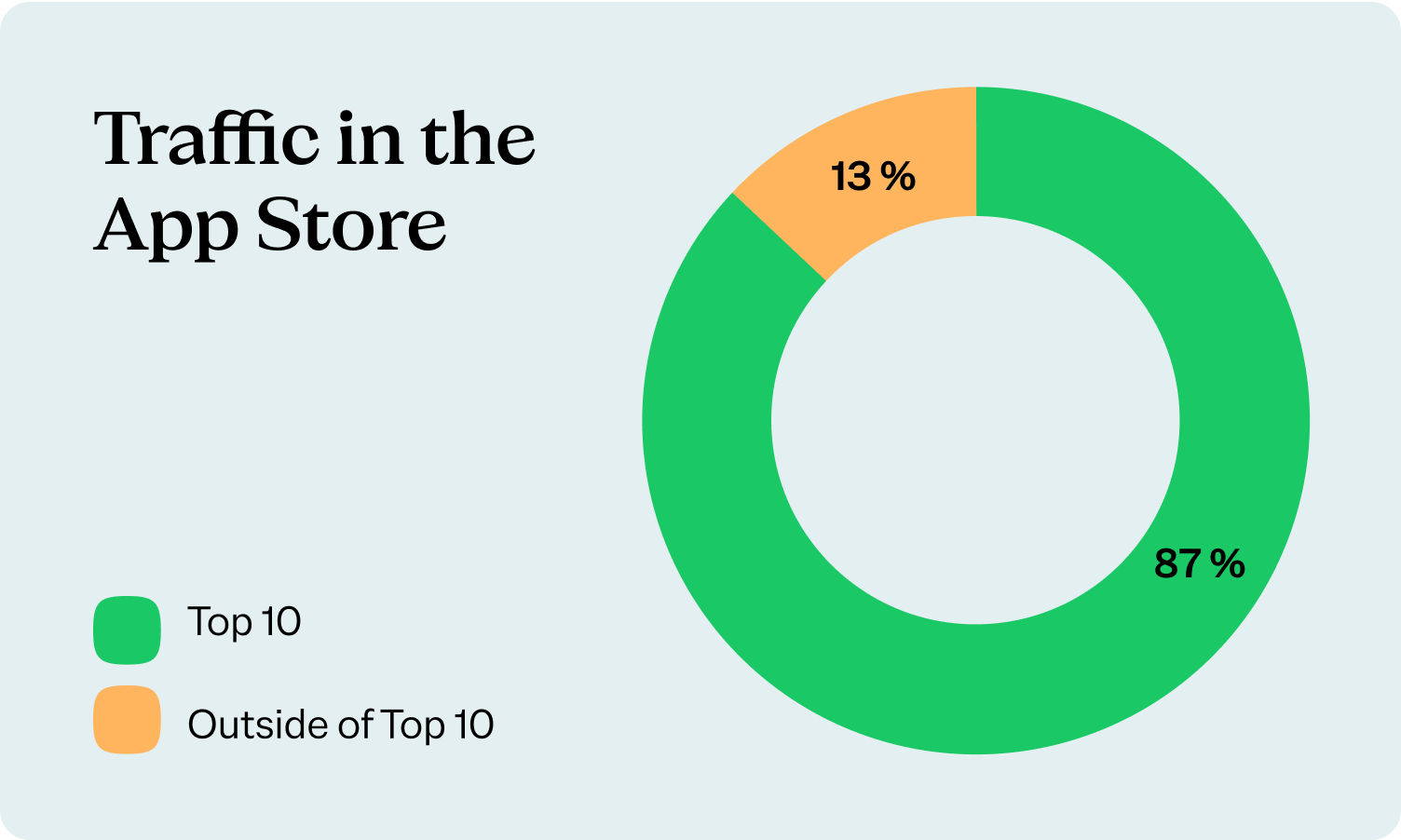
In fact, the top ten apps within each category account for 87% of all traffic in the app stores. With 33 available categories for the Google Play Store, and 24 for Apple App Store, this means that somewhere between 240-330 apps are taking the mother share of all traffic, leaving little to no traction for all other apps.
.jpg "Leaderboard (728x90)")
Why Mediocrity in App Development is Not an Option for Startups and Scale-Ups
The app industry rewards excellence and penalizes mediocrity. For startups and scale-ups, the stakes are even higher: success can mean exponential growth, while failure could result in lost time and resources. Competing in this crowded space requires a commitment to quality, performance, and user-centric design.
Market Dynamics: The Top-Performer Advantage
In the app marketplace, the top 10 apps in a category capture the majority of user engagement and revenue. For startups, this means aiming for excellence is not optional—it is the difference between standing out or getting lost. Whether you are building a subscription platform or a service tool, crafting a high-quality app gives you a competitive edge.
Revenue and Retention: The Key to Sustainable Growth
High-performing apps attract more users with lower acquisition costs, thanks to enhanced visibility in app store rankings. These apps also excel at retaining users through superior experiences, driving higher lifetime value. Startups and scale-ups must focus on creating intuitive, engaging apps that meet user needs to remain competitive.
The Case for Native Development
Native app development, using Swift for iOS or Kotlin for Android, offers unmatched performance, security, and user experience. These factors are crucial for startups seeking to impress investors, attract users, and scale efficiently. Native apps can also better leverage device-specific features, creating a seamless user experience.
Aiming for Excellence
To thrive in the app market, startups and scale-ups must aim high. Investing in superior development ensures better user retention, market visibility, and overall returns. While the initial costs may be significant, the potential rewards far outweigh the risks, especially in a market where being in the top tier defines success.
-1.jpg "Leaderboard (728x90)-1")
This polarization is driven by several factors, including user preferences, app visibility, and the quality of the user experience and, of course, some outliers, such as the social media platforms that generate an intensive amount of downloads. For a deeper understanding into the dynamics of the different market sectors keep reading.
You will find a thorough walkthrough of how different industries and markets have been impacted by the emergence of apps and how this can either give you an opportunity to win the market through aggressive tactics or how it will impose a forced investment for you, just to remain competitive.
The economics of top performers vs. mediocre app
Developing a mobile app can be a costly endeavour, often involving significant investment in terms of time, resources, and money. However, the return on this investment can vary greatly based on the app's market performance.
Revenue concentration: Why leading apps outperform the competition
The top apps in any category often enjoy exponential returns compared to their lower-ranked counterparts. For instance, top apps like Spotify or Instagram dominate their respective categories, capturing the majority of user engagement and revenue. Of course the extent to which this phenomenon is true, varies depending on the nature of the market, with some markets leaving a larger space for several competitors to thrive. This is most often true in the cases where the app is somewhat tied to a physical product or service.
For example, think of ferry apps – in this case the app is tied to the ferry connection which in many cases is only operated by one shipping company, thus the app can act as a tool for upselling, loyalty, and ease of use. However, there is not a “winner takes all” scenario in play when it comes to ferry apps, as a lot of the revenue is tied to the physical offering which it is helping facilitate – the user is taking the ferry no matter what, it’s just a matter of convenience that drives them towards the app. The opposite is true for apps like Spotify and Instagram that have no connection to a physical service or product, so they rely on driving the engagement in the app in order to drive their business growth.
This means, as an app provider, unless you have a physical product, digital domination is essential for driving the intended value from the app.
Want an in-depth understanding of the key factors leading to app success?
User Acquisition costs: How app store algorithms favor top performers
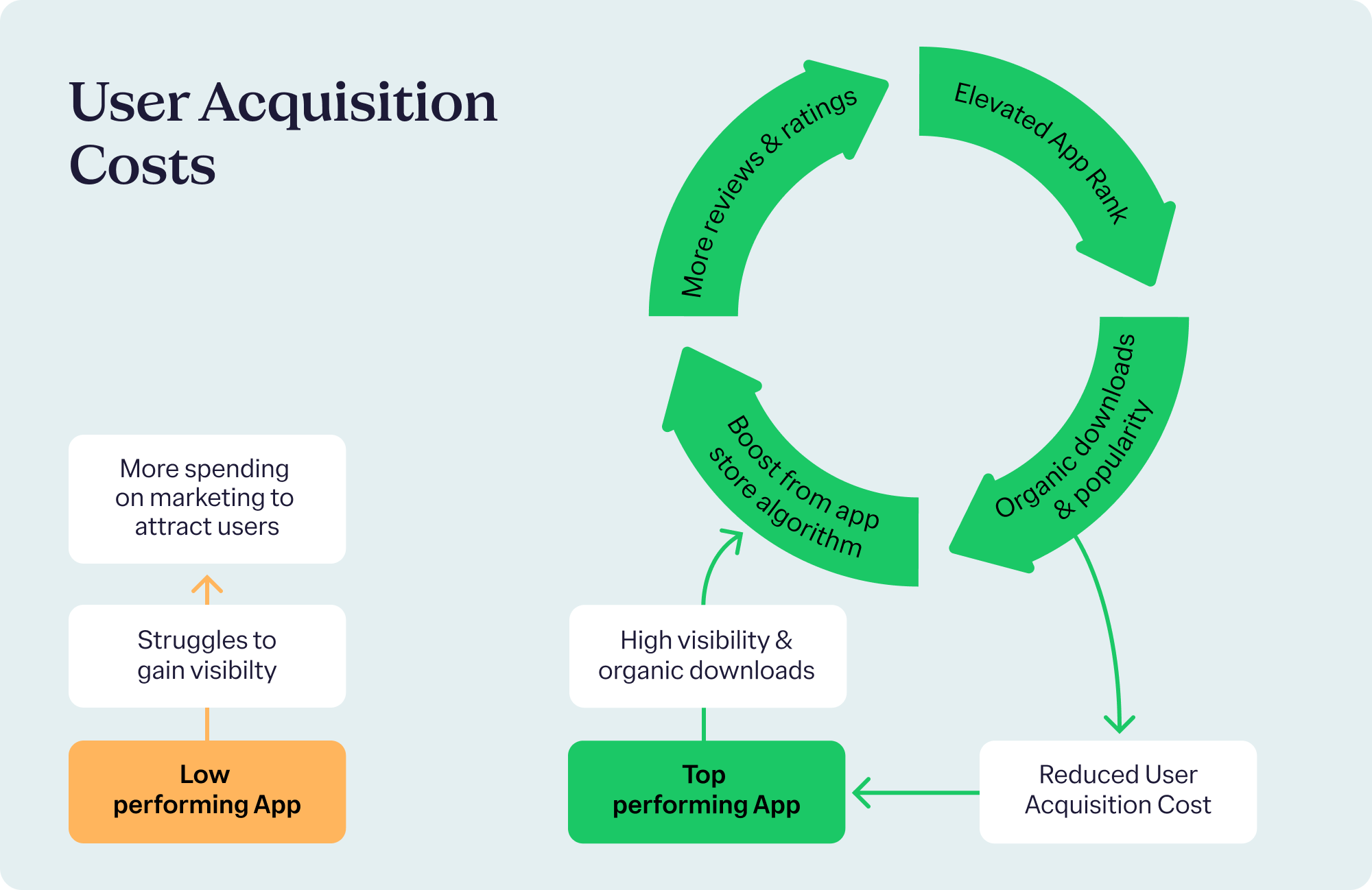
The cost of acquiring new users is typically lower for top-performing apps due to their higher visibility and organic reach. In contrast, mediocre apps may struggle to gain visibility, requiring more spending on marketing and promotion to attract users.
It is no secret that the app store algorithms significantly boosts apps that show high user engagement and satisfaction. A high-ranking app attracts more visibility, leading to increased downloads. These new downloads often translate into more reviews and ratings, which in turn further elevate the app's rank.
This cycle perpetuates itself, creating a positive spiral where visibility breeds more downloads, enhancing the app’s standing on the platform. The higher the app climbs in the rankings, the more it benefits from organic exposure, feeding back into the cycle and perpetuating its success. This all leads to a reduction in the User Acquisition Cost, as a lot of it is driven by the organic reach and popularity.
Engagement and retention: Why top apps excel in keeping users hooked
Top apps also tend to have higher user engagement and retention rates, which are crucial for sustained success. Users are more likely to return to an app that offers a superior experience and value, further widening the gap between top-performing apps and their mediocre counterparts.
For a deeper understanding of how to work with retention and which questions to ask, read the article The App Retention Recipe. This article provides an extensive framework for understanding and working with retention within the app space.
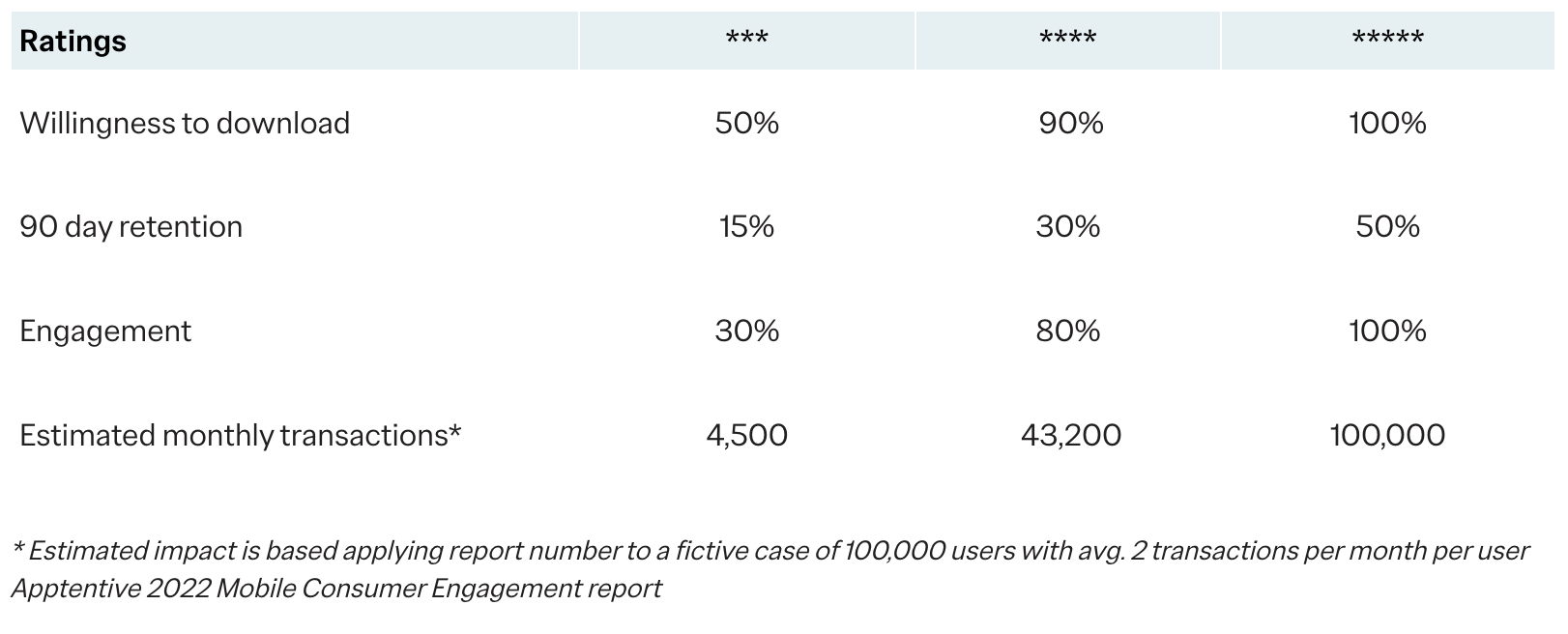
In order to try and quantify the actual effects of this, Apptentive made a study in which they surveyed 100.000 users over the course of two months to understand the effect of app ratings on the monthly interactions with the app (transactions). While there are limitations and blind spots to this survey, it still paints an overall picture that helps support the above standing points.
The risk of mediocrity
Investing in app development without aiming for the top can be risky. Apps that do not reach the top tiers of their market segment often fail to generate sufficient revenue to justify their development costs. Moreover, they face a constant uphill battle in terms of user acquisition and retention, which can lead to a cycle of low profitability and minimal growth.
Benefits of native app development
Choosing the right technological foundation is critical for developing a top-performing app. Native app development, using Swift for iOS and Kotlin for Android, offers several advantages that can help an app stand out in a crowded marketplace, such as.
1. Optimized performance
Native apps are specifically designed for their platforms, offering optimized performance in terms of speed and responsiveness. This can significantly enhance the user experience, making the app more appealing to users.
2. Better integration with device features
Native apps can better leverage device capabilities such as the camera, microphone, and accelerometer. This integration allows for a more seamless and powerful user experience, which can be a crucial differentiator.
3. Higher security
Native development also offers enhanced security features, which are essential for protecting user data and building trust.
4. Consistent UI/UX
Apps developed using native languages can more easily adhere to the specific design guidelines of each platform, ensuring a consistent and intuitive user experience.
Securing market share through top-tier app development
The app industry is not just competitive; it is disproportionately rewarding to those at the top. The difference in value between a mediocre app and a top-performing app can be vast, both in terms of financial returns and market presence. While the investment in high-quality, native app development is significant, the potential returns from becoming a market leader can justify the expenditure. Businesses must therefore carefully consider their strategy and commit to excellence in app development if they aim to capture and sustain significant market share.
As the digital landscape continues to evolve, the stakes will only get higher, making it imperative for businesses to leverage every advantage they can. In this regard, native app development remains a key factor in the quest to build a top-performing app that stands out in a saturated market.