01
Introduction: four drivers carry the signal
Four drivers explain 76 percent of how users perceive product quality. Reach and quality move independently.
This report measures how users perceive nearly 400 mobile apps across Denmark, the Netherlands, and Sweden, based on responses from nearly 13,750 users finalized in early April 2026. Every app is rated only by people who use it. The first chapter tests the signals product teams already track: App Store ratings, install rate, and NPS. Two explain little alone. The rest of the report builds from the model that closes that gap.
7 minutes
Scroll down
Part 1: The signals you already have
Many product teams track visibility, not quality
Two signals dominate most mobile-product dashboards: the App Store rating and the install rate. Both matter commercially. Neither tells you whether users like the product once they are inside it.
Across the apps in the study with a public rating, store ratings explain less than 1 percent of how users perceive quality. Install rate adds little. It tracks how often users open the app, not whether they like it. Reach and quality move independently. The most-installed apps get opened; they are not always loved. Chapter 3 goes deeper on the split.
Both signals measure visibility. They tell a product team how the world finds the product, not whether the product is good. To answer that, product teams needed a different signal
App store rating and App Pulse
App store ratings explain less than 1 percent of how users perceive product quality.
Provided by framna
Correlation: 0.10. App Store and Google Play ratings merged in from the stores themselves for the 377 apps where a public rating is available. Install rate from the MATR survey. App Pulse pooled across markets.
Provided by framna
If neither store rating nor install rate measures product quality, what does?
Most apps work. Most apps are not loved
85 percent of apps carry a negative NPS. Every one of the nine app categories in this study averages below zero, including Finance, the strongest category. Across the full sample of mostly-default mobile apps, the average sits at minus 22.
85%
of apps would not be recommended to a friend.
-22
is the average recommendation score across the market.
Users keep these apps without recommending them. The gap between keeping and recommending is where the real quality conversation lives. The few products that earn positive NPS share one thing: the user feels a clear difference between using the app and doing whatever it replaces. People recommend products that solve a real need well enough to become preferable to the alternative. Time given back, or certainty given back. The rest are held in place by habit, default, or switching cost, and those circumstances change.
Products held in place by habit and inertia are the ones most exposed. Negative NPS today identifies the users most exposed to switching when a competitor or AI alternative reaches them.
NPS distribution across all apps
Provided by framna
Weighted mean NPS: -22. Bars show count of apps in each NPS bucket. Net Promoter Score per product, per market. Weighted by respondent count.
Provided by framna
Is your NPS strong for your category, or only above zero?
Part 2: The App Pulse Model
The App Pulse Model measures what ratings and installs miss
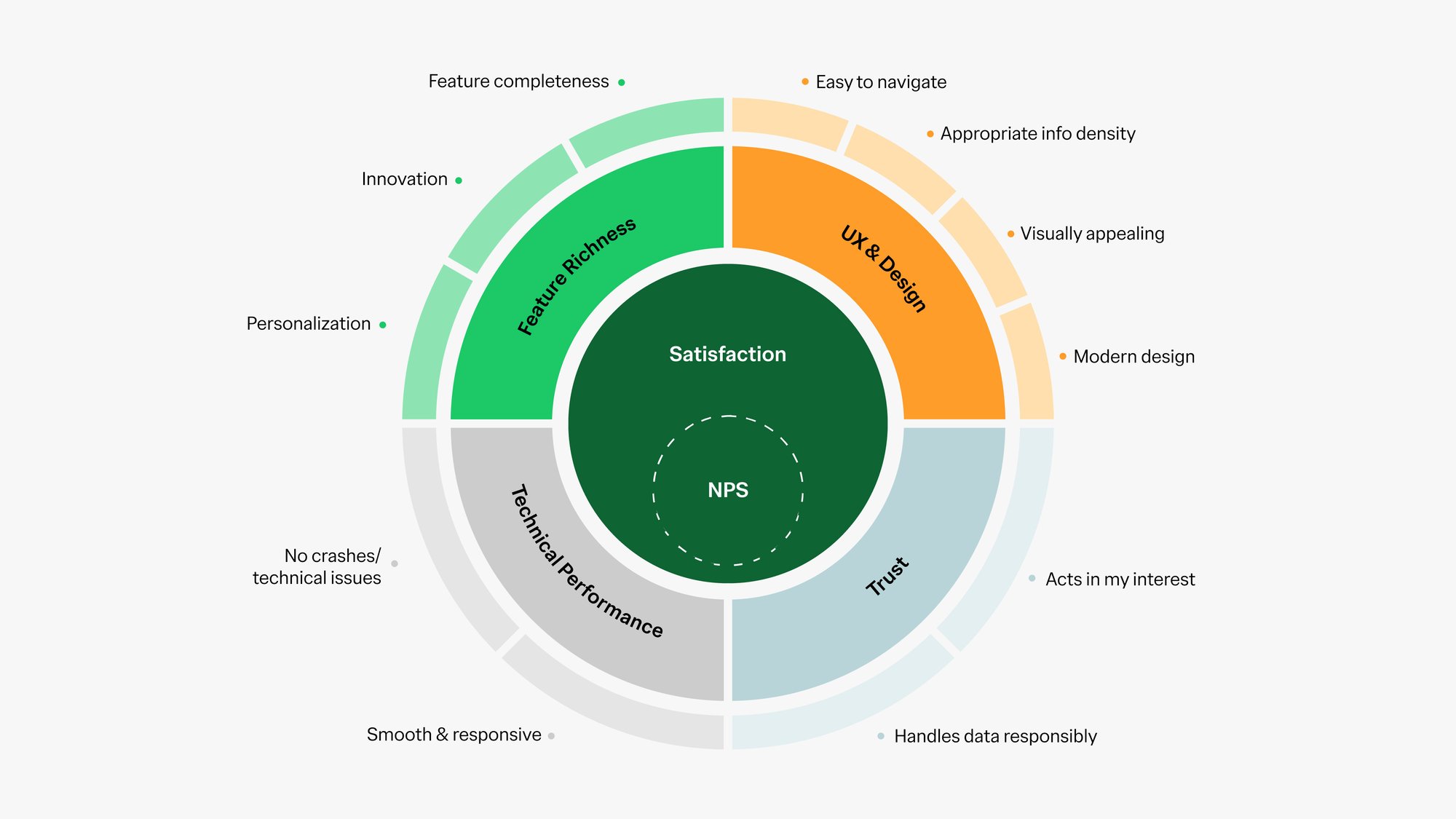
At the center of the model are two questions users answer on a 1 to 5 scale: how satisfied they are with the product overall, and how likely they are to recommend it. Satisfaction carries three-quarters of the App Pulse Score, NPS (rescaled to 1 to 5) the remaining quarter. Satisfaction tracks what users actually experience inside the product. Recommendation tracks that too, but it also picks up habit, category norms, and switching costs.
Four drivers shape both inner questions, each measured on the same 1 to 5 scale: Technical Performance, UX and Design, Trust, and Feature richness. Eleven survey statements sit underneath them, grouped by driver. Each driver score is the weighted average of its statements. The four together explain 76 percent of variance in App Pulse (see 1.4).
NPS gives you a single number. The App Pulse Model gives you a number and a map of where to invest next. The Score places the product against the market; the drivers explain why it sits there.
The App Pulse Model measures perceived quality. Reach is a different question, answered by install rate and usage frequency, and reported alongside the model, not inside it. Chapter 2 brings the two together as a market map.
The App Pulse Model
An inner layer: two questions that produce the App Pulse Score. An outer layer: four drivers, measured through eleven survey statements, that shape it.
Framna's framework for measuring app quality. Reach (install rate, usage frequency) is reported alongside, not inside.
App Pulse combines overall satisfaction (75 percent) and Net Promoter Score rescaled to 1–5 (25 percent) into a single score. The four drivers are averaged from eleven driver statements. Full detail in the methodology appendix.
What would your App Pulse Score reveal about your product?
Four drivers shape how users judge products
The remaining 24 percent comes from things outside the framework:
Content quality
The underlying service the app sits on
Brand loyalty
Switching costs
The user’s own context
The model is built from eleven survey statements, grouped under four drivers. Each driver score is the average of how users rated its statements on a 1 to 5 scale.
These four drivers were not chosen by theory. The data showed each one carries measurable weight in how users rate the products they use.
The four drivers do not change in the AI era. They still explain how users perceive quality. What changes is the bar inside each driver, set by what users have seen possible. As users live with assistant-led products, their expectations shift. The products that hold their position are the ones that shift with them.
How four drivers combine to shape App Pulse
Four drivers built from eleven survey statements.
Provided by framna
The four drivers, with country and category controls, explain 76 percent of App Pulse (drivers alone: 78 percent). Driver importance estimated across 399 products (613 app-market pairs with complete driver data) in three markets. Technique: Johnson's relative importance on a two-way fixed-effects Ridge regression (country and category), with BCa bootstrap confidence intervals. Full detail in the methodology appendix.
Provided by framna
Which of the four drivers is weakest, and is it funded accordingly?
What this means
Finding
Four drivers explain 77 percent of how users perceive product quality. Reach and quality move independently.
Evidence
Nearly 400 products measured across Denmark, the Netherlands, and Sweden, producing 613 app-market pairs. Feature richness, UX and Design, Technical Performance, and Trust carry the signal. Store ratings explain less than 1 percent of perceived quality. Install rate measures reach more than quality.
Implication
Market-level patterns set the bar. Your product’s position inside them sets the priorities.
Why we ran it again
This is the second year. Last year’s questions were not predictive enough. After a year of refining, removing the items that added noise, and rebuilding the model, the four drivers we kept explain 76 percent of how users perceive a product. They do a second job too: hand teams a map of where to invest next, and a reminder of what they are already doing well. We love digital products. We obsess over the users inside them. If this report raises the level of the apps that affect people’s lives, that is the work.