02
What strong apps get right
Strong apps score high across all four drivers, but categories reward different strengths.
Strong apps do not specialize. The leaders in this study score high on all four drivers. Reading the top quartile is not a search for a signature strength. It is a search for what the rest are leaving on the table.
The framework applies to every product. The driver that matters most varies by category and by product, but the pattern of strong apps is the same in every category: height across all four, plus the one thing they finish for the user.
8 minutes
Scroll down
Strong products deliver on every driver
A product team cannot win by doubling down on its strongest driver. The Pulse lift comes from raising the lowest score.
Reading your own profile, look at your lowest of the four driver scores. That is where the next round of investment will move the App Pulse Score the most. If your product is not in the study, the same four-driver test applies. Score your product on each driver, find the lowest, and start there. Search any of the nearly 400 products in the study to compare.
*A note on the sample. The nearly 400 apps in this study were chosen because they already matter in their categories. They start from a higher baseline than the full mobile landscape, where 85 percent of apps carry a negative NPS (the Introduction). “Lowest” here means the lower end of an already strong segment.
What separates the tiers is height across all four drivers
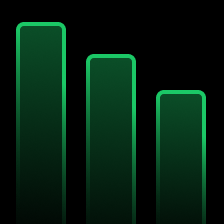
The top quartile is 0.3 to 0.4 points higher than the lower quartile on every driver. No driver pulls ahead of the others inside any tier.
Apps ranked into quartiles by App Pulse across 399 products significant in at least one market. Bars show the average of each of the four drivers within the tier.
Provided by framna
Provided by framna
Which of your four driver scores is lowest, and is your team treating it as the priority?
Leaders complete the job users came for
“Has all needed features” is the single survey statement that tracks App Pulse most closely. Users answer it against the job they came for, not against the category as a whole.
Competitor analysis shows the category baseline: which features are table stakes, what users expect on first use. It does not tell you which job your users want finished. That answer comes from your users, not your competitors.
Operational prompt: Map where users leave the product to complete the job elsewhere.
The test for your own product is one question. Is the job your users came for finished inside the app, or do they have to leave to complete it?
Which driver statements track App Pulse most closely
‘Has all needed features’ tracks App Pulse more closely than any other driver statement.
How tightly each of the eleven driver statements tracks the overall App Pulse Score, ranked. Apps named are among the highest-scoring on the completeness statement.
Provided by framna
Provided by framna
Which job do users open your product to finish?
Every category rewards a different strength
Inside a category the picture changes
Education & Entertainment
Technical performance leads. The product has to play without lag, sync across devices, and remember where users stopped.
Finance & Insurance
UX and Trust both lead. Users need clear flows and confidence the product is acting in their
News & Social Media
Feature richness and Trust carry it. Users come back for relevance and credibility. Polish does nothing.
Car
Feature richness, Trust, and UX all matter here. The product becomes part of the driving habit when all three are strong. Fixing stability alone does not move Pulse, even in Parking apps where tech often fails.
Find your category in the heat map below and read its strongest driver. That is what your users measure your product against. Then use the search at the top of the page to find your specific product, and compare its driver profile to your category’s pattern.
Per-category Ridge regression with country fixed effects and Overall Quality halo control. Mirrors the dashboard's Category Driver Profiles methodology applied to 625 app-country observations across nine categories. Standardized betas show each driver's unique contribution to App Pulse beyond overall app quality. Full detail in the methodology section on the about page.
Which drivers move App Pulse most, by category
Negative values (e.g. UX in News & Social Media) mean more investment in that driver does not lift Pulse for that category.
Provided by framna
Provided by framna
Which job do users open your product to finish?
Two products at the same App Pulse Score can have opposite driver profiles
Digital Post and Headspace sit close on App Pulse — Digital Post 4.0, Headspace 4.2 — yet their driver profiles are mirror images. Pulse measures the level. The driver profile shows what kind of product sits at that level.

Digital Post
Digital Post in Denmark scores App Pulse 4.0. Its Trust score is 4.1; the other three drivers sit at or below 3.7. The product is trusted but flat on experience.
Headspace
Headspace scores App Pulse 4.2, just above, with the inverse profile. Technical Performance and UX and Design both clear 4.0, Feature richness sits at 3.8, and Trust drops to 3.6. The product is experience-led and lighter on trust.
The pattern does not change as product creation accelerates. Strong apps still score high on all four drivers and finish the user’s job cleanly. What changes is where teams spend time. Faster execution raises the value of discovery, judgment, and product direction.
App Pulse pools satisfaction, NPS scaled to 1–5, and the four validated drivers into one score. Driver scores come from eleven survey statements, pooled across markets where the product is significant. ‘Driver profile’ means the underlying combination of the four driver scores: which one a product is high on, which one it is low on.
Same App Pulse, opposite driver profiles
The App Pulse Score places both products at roughly the same quality level. The driver decomposition explains what kind of product each one is.
Provided by framna
Provided by framna
What does your driver profile reveal about the product you have built?
What this means
Finding
Strong apps score high on all four drivers and finish the job users came for. The framework applies to every product; the driver that matters most varies by category.
Evidence
The top quartile leads the lowest by 0.3 to 0.4 points on every driver. “Has all needed features” is the single statement most tightly tracked with App Pulse. Per-category Ridge regression shows different drivers move Pulse in different categories.
Implication
Read your own driver profile, find the lowest, and start there. There is no single recipe; the driver that matters most depends on your category.
What we did not expect
We had a hypothesis when revising this year’s model: top apps are strong on every driver we measure. It held. We reverse-engineered the four drivers from what moves App Pulse, and every one correlates. The leaders score high on all four. No signature strength means no signature weakness either, and a deep moat on one axis is not what the top of the market looks like.