AI
service offering
AI-enhanced product discovery
Reduce product risk before committing to build
Make product decisions with evidence, not assumptions.
Framna’s AI-enhanced product discovery helps teams define the right product direction before committing to delivery.
Teams can build faster than ever. That does not mean they build the right things. Faster delivery has increased the cost of being wrong.
Most product decisions still rely on incomplete understanding:
Product direction is unclear before delivery begins
Assumptions outweigh real user evidence
Teams debate ideas without structured validation
Faster delivery increases the risk of building the wrong product
Product discovery changes this. It shifts decision-making from belief to evidence.
We clarify the problem space, challenge assumptions, explore multiple directions, and validate concepts with real users before build.
AI expands what discovery can do.
It accelerates critique, supports rapid prototyping, and helps uncover patterns in user feedback. Product teams remain responsible for interpreting insights and making decisions.
The result is decision-ready evidence. Clear direction on what to build and why it matters.
What we prove before you build
Discovery produces clear, usable outputs that guide product decisions and reduce risk. The difference is how those outputs are created and used.
We bring product, design, research, and engineering together to shape decisions, use AI where it creates real leverage, and focus on generating the evidence needed to move forward with confidence.
Product leaders
A clear definition of the problem space, user needs, and business context. What is worth solving and why now. Shaped by cross-functional product teams, not isolated research
Assumption mapping
A structured view of the key risks and unknowns that must be validated before delivery. Focused on what needs to be proven to move forward, not just documented
Tested prototypes
Early concepts tested with users to understand what works and what does not. Accelerated through AI-assisted prototyping and critique
Shared context
A foundation of insights and data that teams and AI tools can build on in later stages. Directly connected to design, engineering, and future product development
Who needs product discovery
Product leaders defining direction before committing to build
Digital leaders balancing speed, risk, and long-term strategy
Innovation leaders exploring new product opportunities
Business stakeholders responsible for product investments
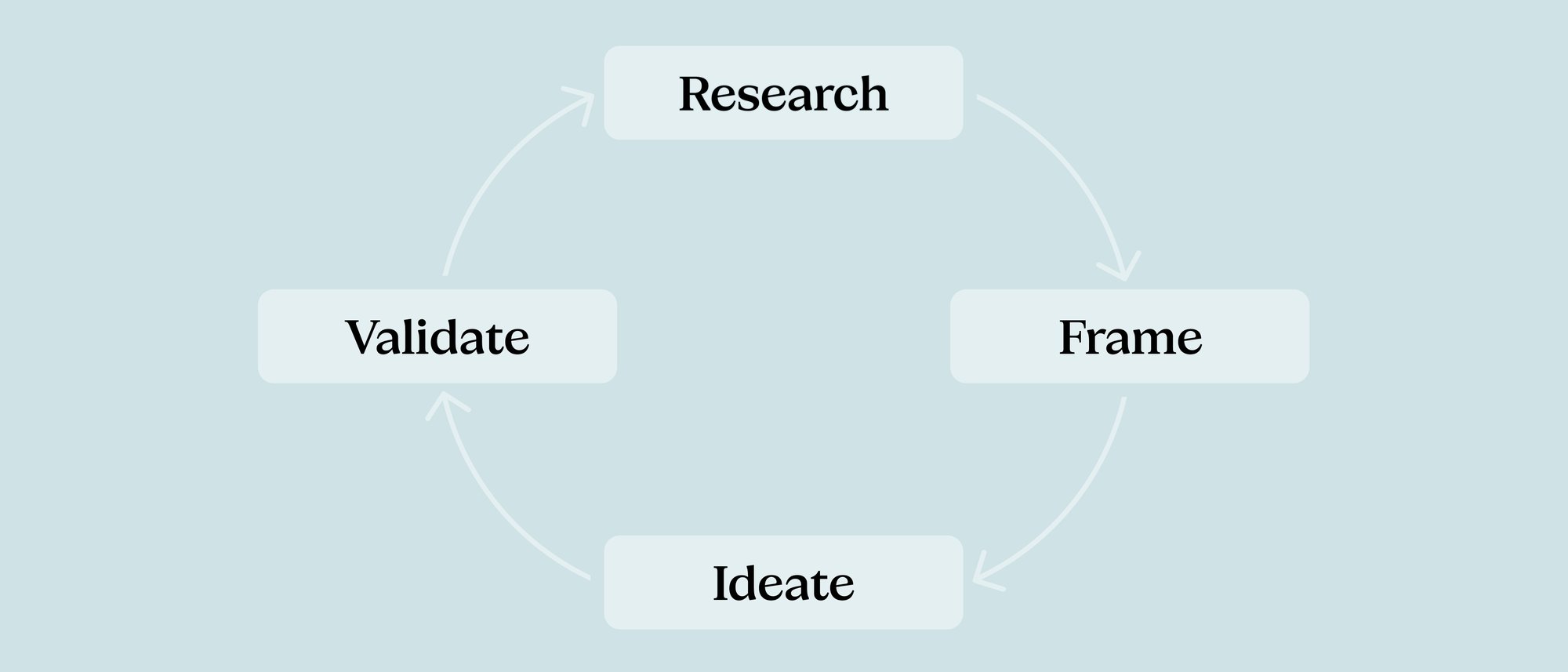
How we reduce product risk
- 01 Research
- 02 Frame
- 03 Ideate
- 04 Validate
Research
Understand the business context, users, assumptions, and key pain points.
- Stakeholder interviews with AI-supported transcription and internal context review
- Initial user insight gathering
- Identification of key assumptions and risks
- AI-supported preparation and research question refinement

Choose the level of discovery you need
Explore an opportunity
A focused session to clarify a product idea, key risks, and next steps
Validate a direction
A short sprint to test concepts with users and generate early evidence
Deep dive into a product opportunity
A broader discovery effort covering research, concept development, and validation
Start with a focused discovery session
Start with a focused session to define your key product questions and risks.
From there, we define the scope needed to generate the evidence required to move forward with confidence.
FAQ
How much can AI replace traditional discovery?
AI does not replace discovery work. It supports it. In this process, AI helps critique ideas, visualize concepts, support prototyping, and analyze user feedback. The discovery process itself remains human-led, ensuring that product decisions are grounded in experience, context, and real user insight.
When do we need discovery versus delivery?
Discovery is most valuable when product direction is unclear, assumptions are untested, or multiple concept directions exist. If the problem and solution are already validated, teams may move directly into delivery. Discovery ensures that delivery investment is focused on the right product direction.
What do we get after one week of discovery?
A short discovery sprint typically produces opportunity framing, an initial assumption map, early concept exploration, and a prototype that can be tested with users. The goal is to quickly generate insight into whether a concept direction deserves deeper investment.
Can discovery run alongside internal product teams?
Yes. Discovery is often run in collaboration with internal product, design, and engineering teams. The goal is to create shared understanding and validated direction that internal teams can continue building.
Where does discovery fit into the product development process?
For new products or major additions, Discovery is typically conducted upfront and followed by a Definition phase, where opportunities and insights are translated into concepts and roadmaps. This usually includes more extensive prototyping, feasibility assessment, and estimation, resulting in a clear investment proposal for delivery.
Mature teams also embed discovery into their ongoing work, continuous discovery.
Ready to get started?