
The App Pulse score explained

insights_blog_app_pulse_header_1848x792-1

In a saturated app marketplace, download numbers and App Store ratings only reveal part of the story. Even widely used benchmarks like NPS or CSAT lack crucial context, such as: are users engaging by choice, or by necessity?

At Framna, we developed the App Pulse score as part of our proprietary research methodology. It is the foundation of our annual Mobile App Trends Report, and functions as a unified benchmark for evaluating mobile app quality based on real user feedback.
What is the App Pulse score?

The App Pulse score measures an app’s success across four user-rated dimensions:

  • Relevance: Does the app solve a real user need? 

  • Value: Does it deliver tangible benefits or experiences?

  • Satisfaction: How do users rate the overall experience?

  • Best of its kind: How does it compare to other apps in the same category?

Each dimension is equally weighted, scored on a Likert scale (1-5), and then normalized into a 0-100 score. This multidimensional benchmark enables meaningful comparisons across markets, segments, and use cases, highlighting what drives long-term user trust and engagement.

What the score reveals

Rather than focusing on usage or installs alone, the App Pulse score offers a high-level snapshot of an app’s perceived quality within its category. While it does not claim to measure user preferences directly, it signals how an app is performing overall compared to its competitors. This makes it a useful starting point for assessing performance beyond surface-level metrics. To understand the reasons behind this performance, the App Pulse drivers provide deeper context on which aspects of execution matter most for user satisfaction and sustainable growth, offering strong potential to guide meaningful product conversations.


Understanding context through driver analysis

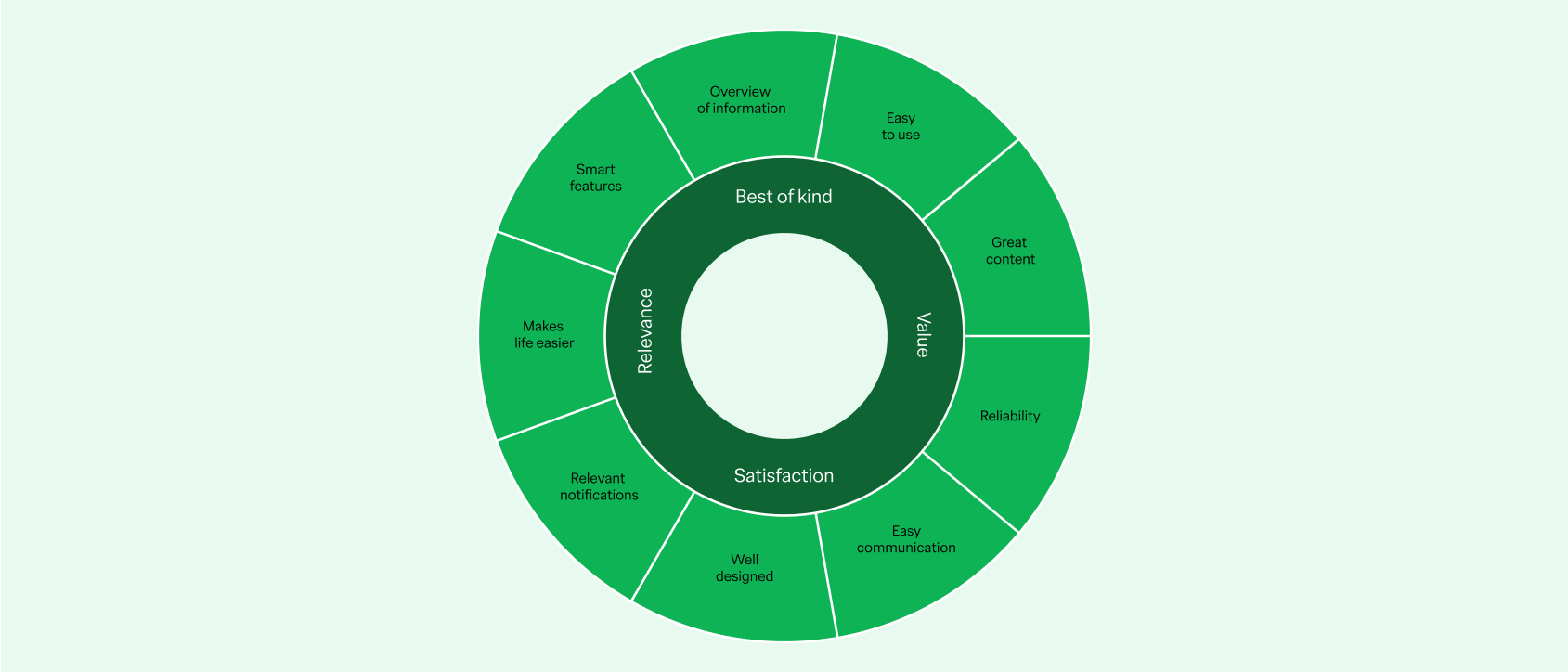
This deeper context is where the real insights live. In addition to the score, our annual App Pulse study includes a driver analysis that reveals what characteristics most strongly correlate with high user ratings. These nine operational drivers, such as usability, trust, smart features, and content quality, add critical context alongside free text answers. These factors do not affect the score directly, but they help explain why top-rated apps stand out, how digital product teams can differentiate from competitors, and where app providers struggle in a market that continues to mature digitally.

App Pulse model
The App Pulse framework, with the four user-rated dimensions (inner circle) and the nine operational drivers (outer circle)
Why it matters

User expectations are rising, and app success increasingly depends on more than functional performance alone. The App Pulse framework offers a shared language for capturing user impact, combining a broad performance snapshot with deep, qualitative insights through the drivers. While no single score can perfectly define product excellence, this model brings together signals that are often overlooked in standard metrics like average ratings or technical KPIs. It provides a more complete perspective on what success really looks like and where to focus next.

Access the Mobile App Trends Report 2025

Curious to see how different apps rank based on the App Pulse score? Dive into our Mobile App Trends Report 2025, based on data from over 600 apps and 9,000 users across Northern Europe. Explore benchmarks, success stories, and in-depth sector insights.