Emerging interaction patterns

Oscar Sellhed
Business Designer

New intelligence inside a product tends to force a bigger question: what does interaction itself look like going forward? And whenever that question comes up, people usually jump straight to devices.
We've watched a few of these fail to break out already, like the Humane Pin, discontinued within a year after selling a fraction of its projected 100,000 units. OpenAI is reportedly building something with Jony Ive next, and smart glasses are climbing too, but it's early to say whether either turns out to be an enthusiast gadget or a useful tool for everyone.
None of these has been the breakout moment some people expected. Looking at the pattern, it's not hard to see why. Clicking is still winning. But a third interface has quietly slipped in between it and chat.
We keep trying to kill the click, but it keeps winning
Every serious attempt to replace the clickable interface has failed so far. Clicking is still the most convenient way to interact with a product, and most people would agree with that the moment you ask them directly.
Go back before 1983, before direct manipulation existed, and interfaces looked like languages such as BASIC: you wrote out your intention, and the computer executed it, oddly close to how we talk to AI today. What changed everything was clicking itself: once direct manipulation arrived, far more people outside the technical world started using computers, because pointing at something is so much easier than putting your intention into exact words. We'd like to think agents can do everything faster and better. But we still like clicking and pinching to stay in control of the interface. There's real data behind this, not just intuition:
Spotify
Ran agents against human users on fairly complex platform tasks. Completion rates came out roughly even. The agents were five times slower.
OpenAI
Shut down the Atlas browser after less than a year. Users preferred browsing the web themselves over explaining their intent to get to a page.
Starbucks
Released a ChatGPT app this April. Ordering a coffee through the existing Starbucks app takes about 20 seconds. The same order through ChatGPT took close to two minutes.
None of this means AI has no place in interaction. It clearly does. It just doesn't have the place people assumed a couple of years ago.
So where does AI actually earn its place?
AI shines on genuinely complex tasks: planning something, or pulling several sources of information together into one answer. Think honestly about the moments you actually reach for it. It's rarely for the thing you already know exactly how to do.
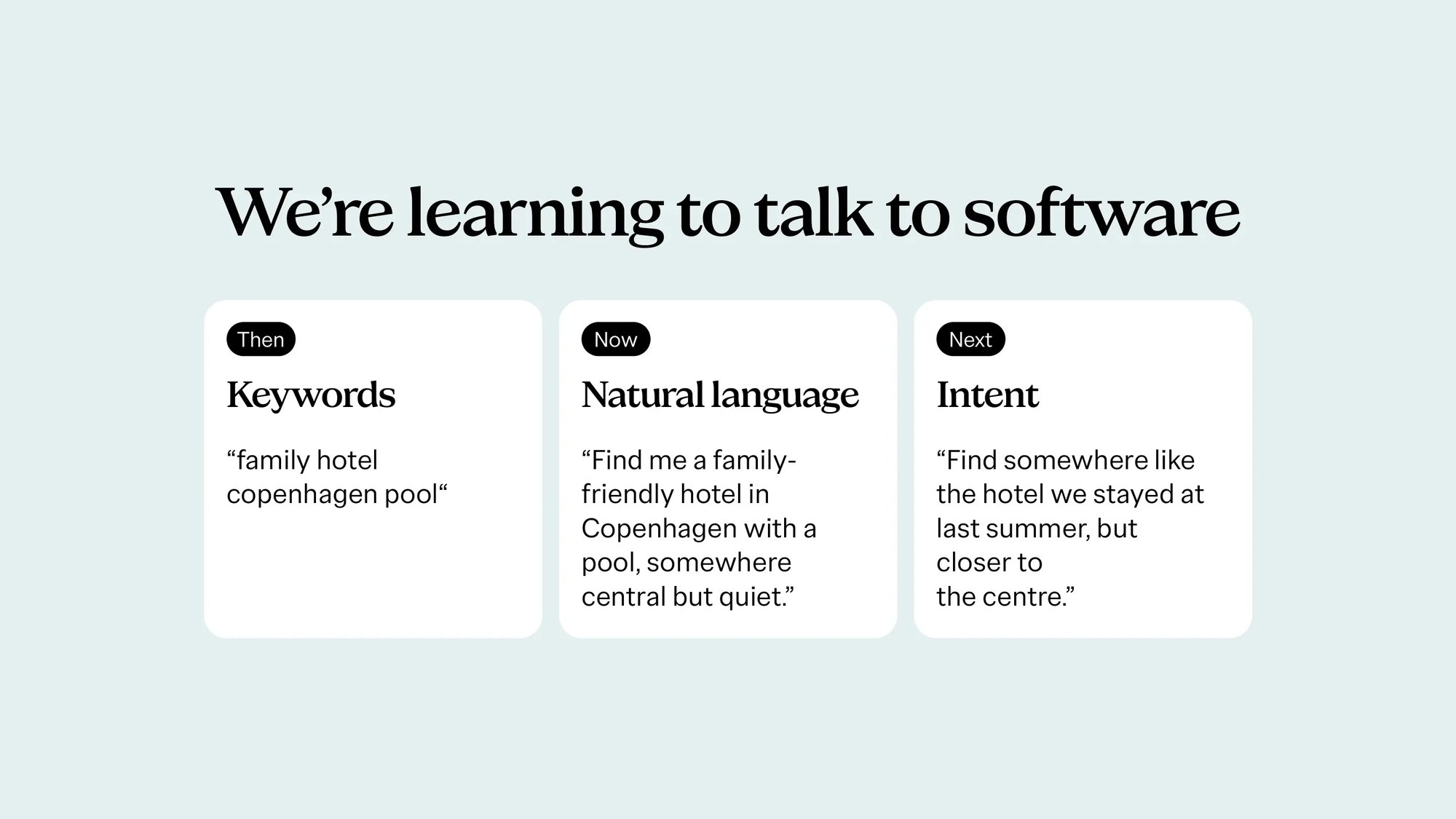
Low-complexity tasks, the ones people already know how to do, are still best served by traditional clickable interfaces: it's simply faster to click than to explain. High-complexity tasks are where agents and chat genuinely help, because they support working from intent rather than a known sequence of steps. However, what's actually interesting is what's forming in the middle.
The middle ground: generative UI
Search "pH scale" on Google today and you get the usual AI text answer, but alongside it, an interactive scale you didn't ask for by name. Ask a follow-up, say how different citrus fruits compare on that same scale, and it builds you an interactive version you can drag and explore. Google isn't just generating text anymore, it's generating the interface that carries it.
This is generative UI, or GenUI, and it's the pattern worth watching closely right now. GenUI is a layer where the AI assembles the interface while someone is actively using it, building the experience around them as they go rather than presenting a screen a designer finished in advance for every possible user. There are three levels to this worth knowing:
Static GenUI
A designer has already built a specific widget, a checklist for example, and the AI fills it in for you during a chat: adding items, checking things off, adjusting it as you talk. Take an app called Just Today: it turns "wash the car, clean the house, return library books, buy groceries" into a working checklist inside the chat. It's the lightest layer of GenUI, using the AI's understanding to populate something a person already designed.
Declarative GenUI
A step further. Take a landscaping app called Verdure: you upload a photo of your garden, it reads what's in the picture, asks a short series of questions about how you want the space to feel, then generates a design suggestion with a price estimate. Before this kind of interface existed, you'd have had to type all of that out yourself, in plain text. Here, the interface itself does the work of shaping your input.
Open-ended GenUI
The rarest of the three, and the most striking when it works. Someone typed a single prompt into ChatGPT: "Create a simulation of the journey of Odysseus on a map, let a ship represent him and his crew in the simulation and add an icon to each of the adventure that he faced during his travels." ChatGPT researched the actual geography, Cambridge University sources included, then generated an entire interactive map of Greece, Italy and the Mediterranean, with controls to adjust speed and explore different regions. As the ship reached each stop, a short introduction to that part of the story appeared. Map, controls and narrative beats: the whole interface was rendered by AI from that one prompt, nothing else.
We first noticed this trend building back in 2024. Two years later, we're standing right in the middle of it, and it changes what building even means: less fixed screens, more planting something and shaping how it grows.
What this means for product design
Two things stand out.
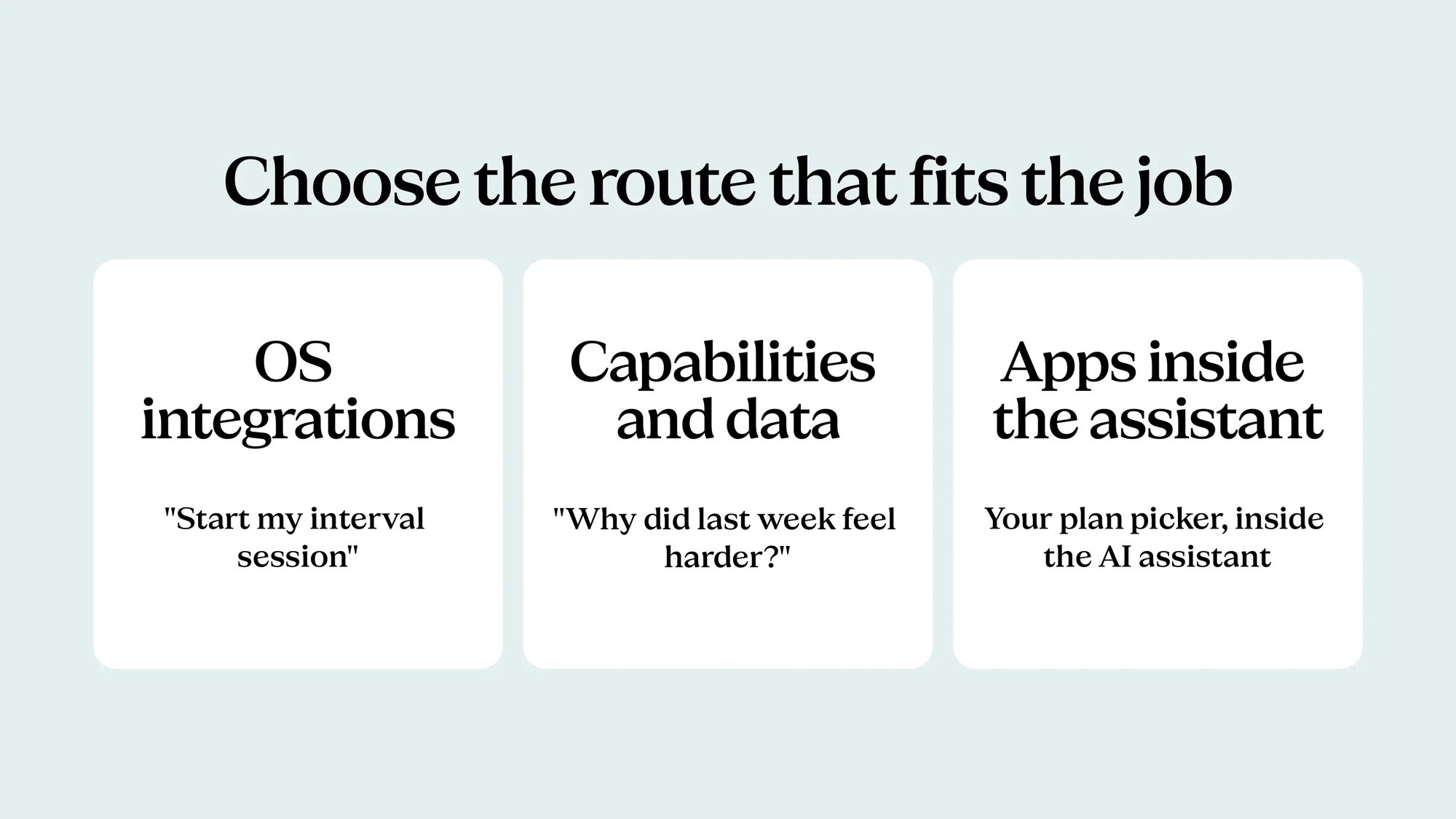
First, we're moving from fixed screens to modular building blocks. Design systems aren't new, but what's new is that AI can now take the knowledge encoded in a design system and assemble it in ways nobody explicitly designed for.
From fixed screens to modular blocks
Product teams build modular visual "LEGO blocks" that the AI assembles for the user, rather than shipping one fixed layout for everyone.
Building interfaces to support complex input
This is what helps bridge the gap between low-complexity tasks and the higher-complexity ones we still need to support people through.
That shift brings real challenges, not small ones. Predictable layouts are one of the best things about most products today: you learn where to click once, and that knowledge stays useful. Brand consistency is another, because nobody fully controls what actually gets generated and rendered for a given person in a given moment.
Second, this is about building interfaces that support complex input. GenUI points toward a future where people don't need to get good at prompting at all, because the interface itself does that work, the way Verdure turned a vague request into a short series of easy questions. The tradeoff: a single, learnable interaction pattern gets harder to guarantee, since the AI assembles something fresh each time instead of the one interface everyone already knows.
We genuinely don't know the shape of this yet
We don't know how big this shift ends up being, or what it looks like once it settles. It might resemble one of the device attempts we've already seen, or none of them. What we can say with confidence is that it's going to play a real role in how people interact with products going forward.
Clicking still wins for low-complexity, well-understood tasks. Don't replace what already works.
Agents and chat earn their place on genuinely complex, intent-driven tasks.
GenUI is the pattern forming in between, worth watching and prototyping now.
Product teams are shifting from fixed screens to modular blocks the AI assembles.
The most useful thing any of us can do right now isn't to wait for certainty. It's experimenting with the technology, thinking seriously about where it's headed, learning from what happens, and continuing to invest in it and grow with it.
Ready to explore what's forming in between?
If you're weighing where a more intelligent, more assembled interface could genuinely help your users, rather than replacing the click for its own sake, we'd be glad to think it through with you. Get in touch and we'll help you map where clicking still wins, and where it's worth exploring what's in between.
Subscribe
Join our newsletter and stay up-to-date