Where should intelligence live?

Fredrik Björndahl

Fredrik Björndahl

Senior Product Lead

Insights_Blog_AI_Grounding_NL_Header_1848x792
 
When I run, I collect all my training data in Strava. When I actually want to understand that data, or get some coaching out of it, I don't open Strava. I bring the data to Claude instead.
 
That's a small, personal habit, but it points to a bigger question every product team is now facing: where should intelligence live? Inside your product, where you build and control the whole experience? Or outside it, in the assistant your customer already has open - Gemini, Siri, Claude?
 
That's not just a fitness question. Products no longer compete only with others in their category. They compete with whatever AI system a user decides to try the same task in instead.
The bar quietly went up

Expectations spread fast between categories. Once someone gets used to a product remembering their context, or suggesting the next step for them, they start expecting that everywhere else too. Most products aren't delivering on it.


85% of the 400 apps surveyed in our Mobile App Trends Report have a negative net promoter score.


People keep using those apps anyway, often out of habit, or simply because they're the default choice already on the phone. Usage and satisfaction aren't the same thing. A product can fall behind what customers expect long before those customers actually walk away. That doesn't make it irrelevant. It raises the bar for what counts as good.


Strava vs. Google: two different bets

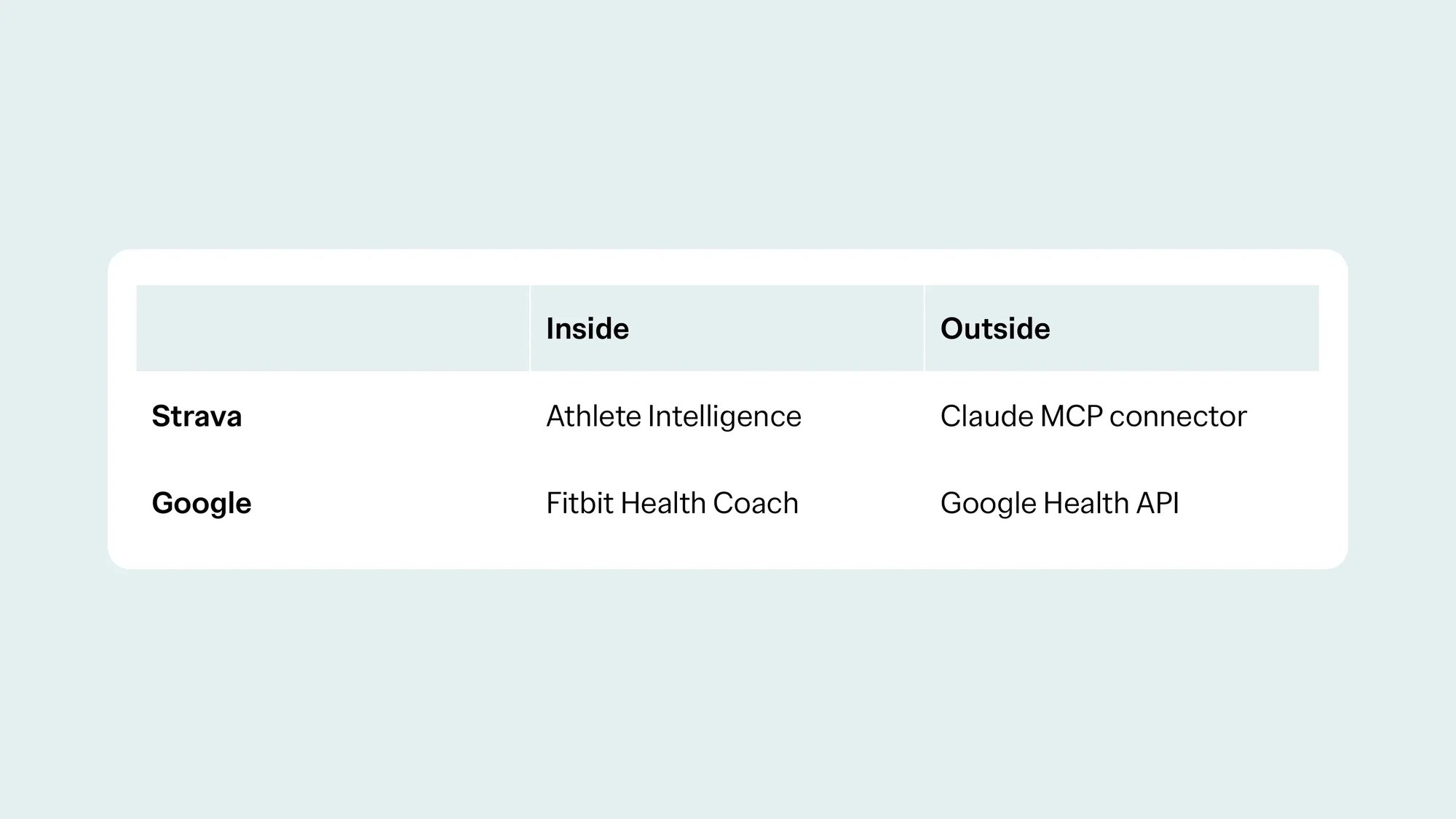
Strava calls its AI feature "Athlete Intelligence." It summarizes your activities and, if you've set a goal, works that into the summary too (something like "a great interval session, that's great for your 10k race in June"). You also get a weekly batch of workout suggestions. That's roughly the extent of it.


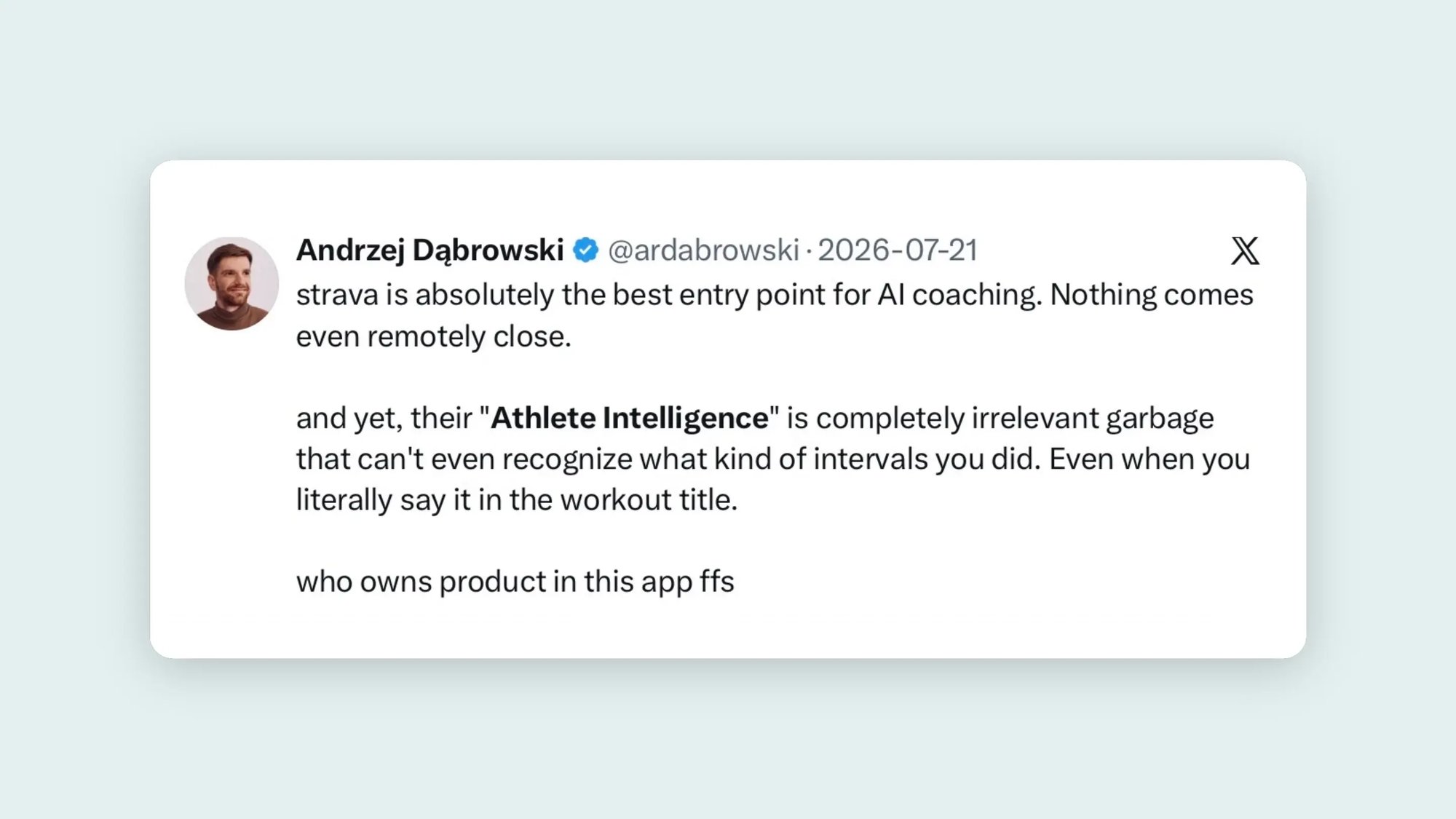
Judging by the reaction online, plenty of people find it underwhelming. Andrzej Dąbrowski put it sharply on X in July: "Strava is absolutely the best entry point for AI coaching. Nothing comes even remotely close. and yet, their 'Athlete Intelligence' is completely irrelevant garbage that can't even recognize what kind of intervals you did. Even when you literally say it in the workout title."

slide-4

Now look at Google's Fitbit app. Since May, it's shipped an AI feature Google calls "Fitbit Health Coach," built directly into an app that already existed. It reads sleep, recovery, and workout data and explains what that data actually means for you, and given access, it can factor in more of your life, like whether you worked late or slept badly, to adjust your training schedule.


The question was never whether a product can generate a summary. It's whether the summary is actually useful. On that measure, Google's Fitbit has done a noticeably better job than Strava's Athlete Intelligence.

slide-2
Different calls, different reach

Strava and Google made different calls here too. Strava enabled a Claude MCP connector for your training data (not the social layer), while Google exposes Fitbit data through a developer-facing API, meant for building on, not for asking an assistant directly. The practical difference is reach: a connector only works for people who know it exists and set it up themselves, while a coach built directly into the app reaches everyone who opens it, no extra steps required.

Two questions worth asking:

And here's the part worth sitting with: even with an underwhelming AI feature, I still open Strava daily, mostly for kudos. That's Strava's real moat, a social layer no outside assistant can replicate. Claude helps me understand my training; it doesn't replace what I get from opening Strava itself. Different jobs, different right answers.


Where does the useful context actually come together?

  • Is it around the user? Training data, a work calendar, travel plans. Combining these needs an assistant that can see across a user's whole life, which points outside the product.

  • Is it around the product? How similar athletes progressed, training-plan logic, available routes. This context belongs to the product itself, and gives it real insight even when it's not handing over a final answer.

Where does the user actually get the value?

  • Is it mainly in the result? "How far did I run this week?" Every extra step between the user and that number is friction, a strong candidate to open up.

  • Is it mainly in the interaction? "Understand my progress." The value sits in the conversation itself, worth owning inside the product because it builds trust and brings people back.

slide-3
Three levels of access

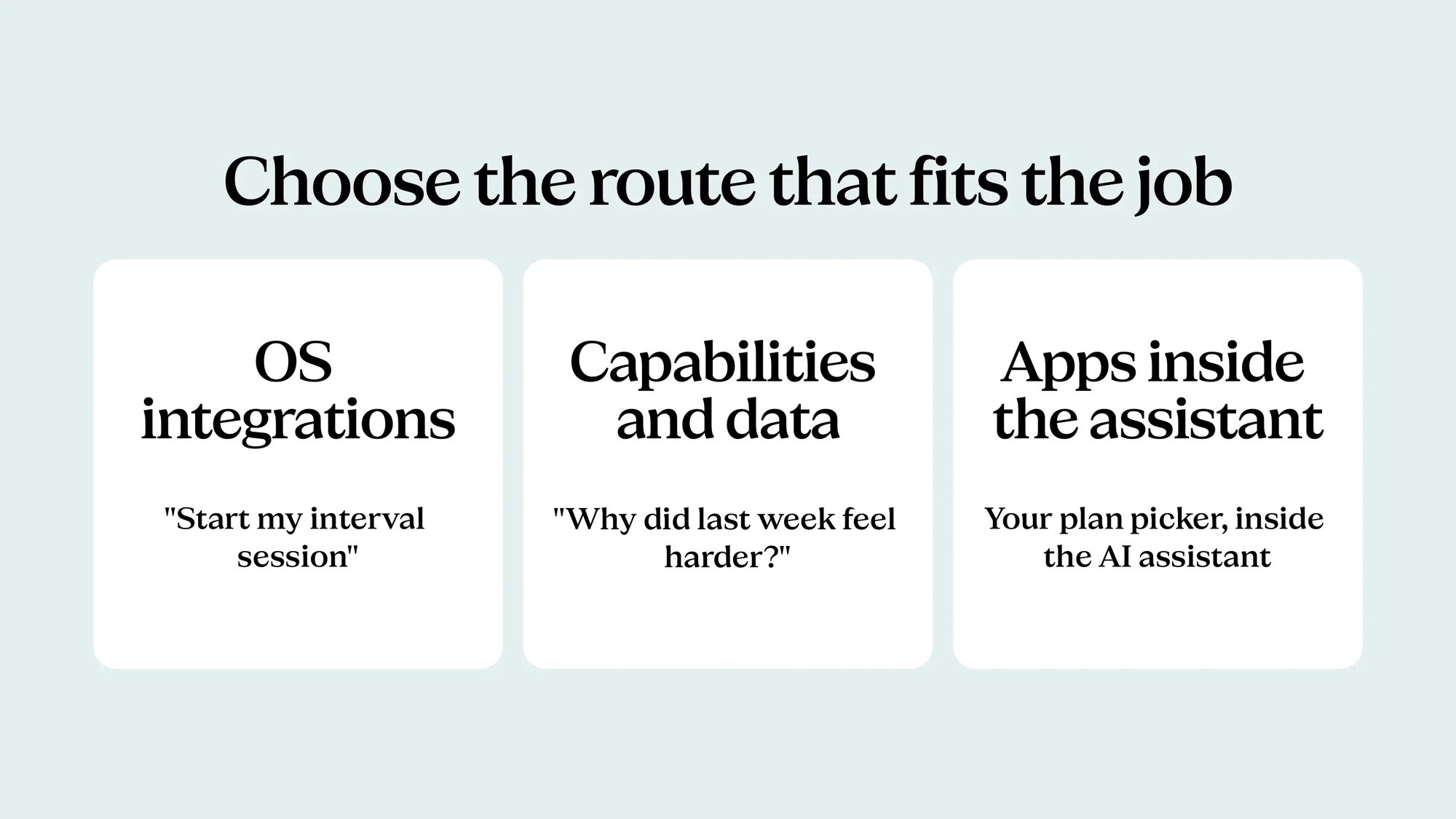
OS Integrations

iOS App Intents, Android App Functions: simple, single actions exposed at the operating-system level. A job like "start my interval session" doesn't need a conversation or an interface at all; Siri or Gemini can just do it.

Capabilities and data

Via an MCP server or connector, the assistant can combine your product's data with context from elsewhere. "Why did last week feel harder?" needs this level, since answering it means pulling in sleep and calendar data no simple app intent would expose.

Apps inside the assistant

MCP apps, ChatGPT apps: a full interactive interface, brought right into the conversation, with MCP running underneath it. Choosing a training plan needs comparison and controls that a plain text answer can't really deliver.

When it's actually worth it

Open up when you can point to two things: a clearly better outcome for the customer, and a measurable benefit for the business. If you can only name one, keep the capability inside for now, or run a smaller experiment first. Technical possibility alone was never a good enough reason.


AI assistants have raised what every product needs to clear. That doesn't mean handing your customer relationship over to whichever assistant they happen to be using. Your own product can still be the best place for someone to understand their own data, explore options, and build trust in what they're seeing.


Where intelligence belongs is different for every product. It can sit inside the product, or outside it, in integrations with external assistants and agents. We run a short discovery sprint with your team to map where intelligence genuinely pays off for your users, and what a first version of it looks like.


  • Map where the value sits. We explore the use cases that matter to your users, and where intelligence can create value more effectively than what exists today.

  • Prototype before you commit. We build and test promising solutions as part of the sprint, so you get early validation from real users before investing in a full build.

Subscribe

Join our newsletter and stay up-to-date