Your users changed. Did your product?

Claudia Velhas
Product Designer

We've spent the last fifteen or twenty years learning how to use digital products, and by now most of us do it without thinking: open the app, search, filter, fill in the form. That whole sequence stopped feeling like work a long time ago.
What's changing is the behaviour itself, not the products. ChatGPT, Gemini and the other AI systems we've all picked up are quietly rewriting the instincts underneath that sequence, and at Framna we keep running into the same three shifts with the people and partners we work with. Your users have already picked them up. The question is whether your product has.
1. We're learning to talk to software
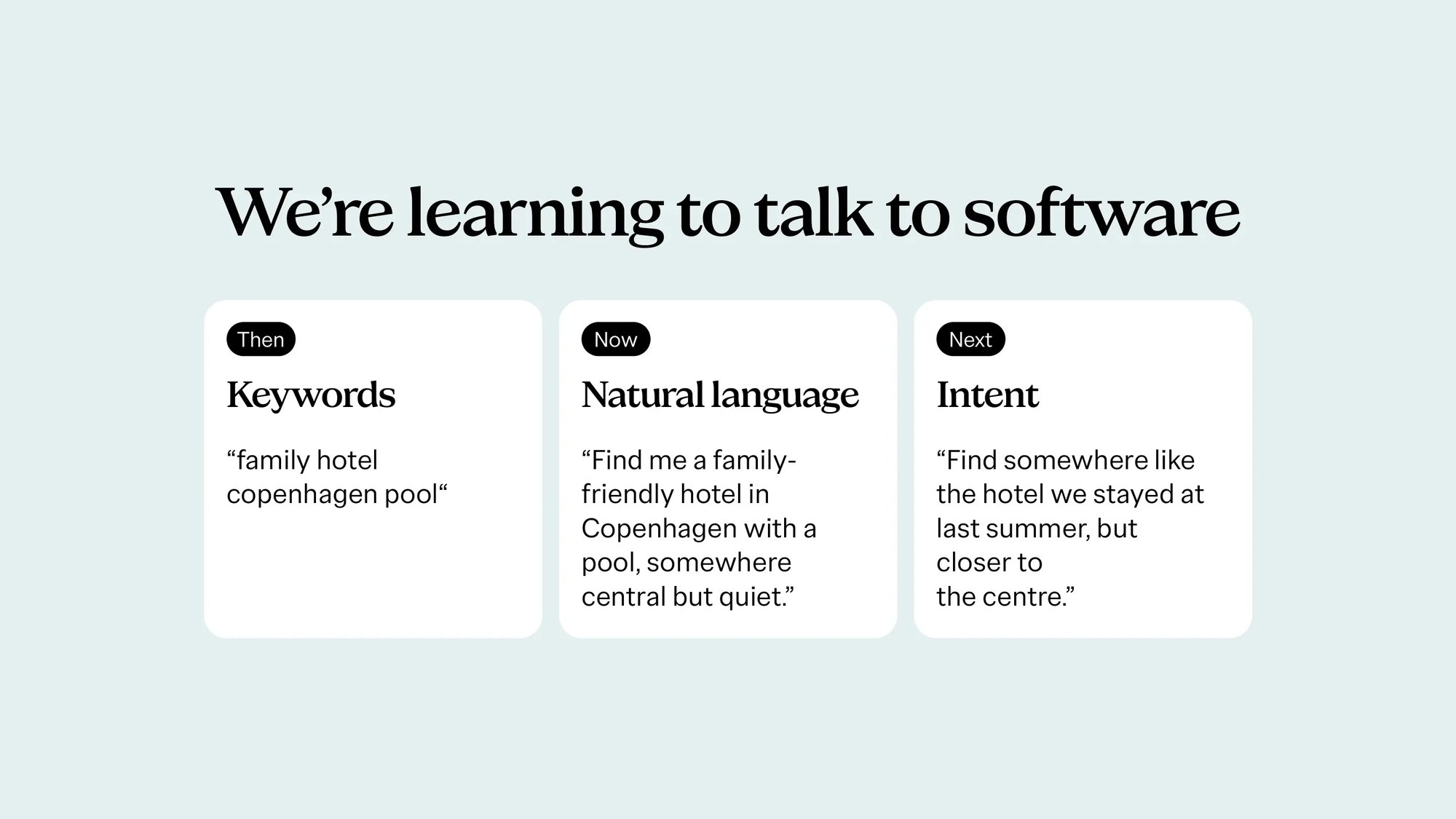
Search is the clearest place to watch this happen. For years, the job was to take what you actually wanted and translate it into keywords a search box could understand: "family hotel copenhagen pool" instead of an actual sentence.
Large language models are teaching the opposite instinct: just say what you mean. Ask for "a family-friendly hotel in Copenhagen with a pool, somewhere central but quiet" and you're understood outright. There's a level past even that too, where people start layering in memory and context the way they would with a person who already knows them: "find somewhere like the hotel we stayed at last summer, but closer to the centre."
Once someone gets used to describing rather than keyword-guessing, plain search boxes elsewhere start to feel broken. In a world where you can search, why would you settle for that when you could just ask?
The big platforms are already building for this. Ask YouTube how to teach a kid to ride a bike, and instead of scrolling through search results, it drops you straight into the exact timestamp of the video that actually answers it.
None of this means the new behaviour arrives fully formed the moment it's technically possible. In our own work with partners, we keep seeing people default to keywords, because that's the muscle memory years of search boxes have built. The old mental model doesn't vanish overnight. A new interaction becoming possible doesn't mean it immediately becomes natural.
What we've noticed however is the moment it clicks. People try natural language once, realise it actually works, and something shifts. Whether that habit fully sticks everywhere is still an open question. But it's the direction worth designing for now, not after it's obvious.
2. We expect products to know more about us
Every time you give a product context and it remembers that context successfully, the memory quietly turns into an expectation. Apple's newer Siri is a useful example here: it's designed to draw on personal context, like finding a friend's door code buried somewhere in your messages, and on what Apple calls onscreen awareness, answering a question about whatever's on your screen right now.
Personal context
What the product already knows about you, your habits, your history, the things you've told it without meaning to teach it anything.
Onscreen awareness
What the product can see right now, in the moment, without you having to explain it.
But how much context is too much? This is where real friction shows up, because people tend to want two contradictory things at once. Be known, so I never have to repeat myself. And also: how do you know that? What else do you know about me? Can I turn this off? More intelligence raises real questions about trust and control the industry hasn't fully answered. Worth designing for on purpose, not discovering the hard way.
3. We expect products to do more of the work for us
There's a spectrum here, and it's worth naming its full range. Because moving along this spectrum, the product takes on more of the work, but the person also has to place more trust in it. That trade-off is the whole design problem.
I do the work
Manual effort, the user drives every step, nothing happens without direct input.
Product assists
The product suggests and speeds things up, but the person is still steering.
Product acts
The product acts on its own when needed, and the person hands over more control in exchange for less effort.
We've explored this with several partners. In the Afa Insurance app, reporting a workplace injury used to mean filling out a form, a bad task to hand someone who's just been hurt. We built a voice-first alternative instead: you talk, it turns that into a completed report, and you just confirm it before submitting. The result: reporting goes from a tedious form to under a minute of talking, and more incidents actually get reported.
Why this matters beyond your own product
New experiences teach new behaviours, but only when they're genuinely useful. ChatGPT alone has shown millions of people that you don't need the right keywords or the right command; you can just explain what you want. When a behaviour like that sticks, it doesn't stay contained inside the product that taught it: new experiences introduce a genuinely better way of doing something, new behaviours form once enough people try it and it works, new expectations follow because a good experience anywhere raises the bar everywhere, and pressure builds on other products whether or not they had anything to do with it.
New behaviours aren't automatic, though: a new interaction becoming possible isn't the same as people adopting it. That's exactly why understanding behaviour outside your own product matters now. Product research can't just ask how people use your product; it has to ask what else is shaping them, what other products are quietly teaching them to expect.
You're no longer just competing with the other products in your category. You're competing with the smartest experience your user had yesterday, wherever they had it.
New experiences introduce a genuinely better way of doing something.
New behaviours form once enough people try it and it works.
New expectations follow, because a good experience anywhere raises the bar everywhere.
Pressure builds on other products, whether or not they had anything to do with it.
Your users changed. Did your product?
If your customers are starting to ask instead of search, expect more context than your product gives them, or expect it to do more of the work on their behalf, that's worth exploring properly rather than reacting to feature by feature. Get in touch and we'll help you map where the gap is, and what to do about it.
Subscribe
Join our newsletter and stay up-to-date