The state of AI in digital product work 2026
Inside the companies that build digital products, AI has moved into the work itself. It writes code, drafts designs and checks releases. Outside them, more and more people ask an assistant a question in their own words and get an answer shaped around them. Then they open an app that offers the same menu it offers everyone else.
We wanted to know whether the change inside these companies is closing the gap opened outside them. At Framna we work on both sides of that gap, with our partners and in our own company. In September 2026 we asked 530 people who design, build and lead digital products how far AI has come in their organization, and what is in the way.
Key findings
530 respondents
AI has changed how products are built. Less has changed in what users get.
01
AI has made users expect more, but fewer than half say their product has caught up.
55% say AI has made their users expect more. 42% say their product has adapted.
02
Product teams ship more, but fewer than half deliver faster.
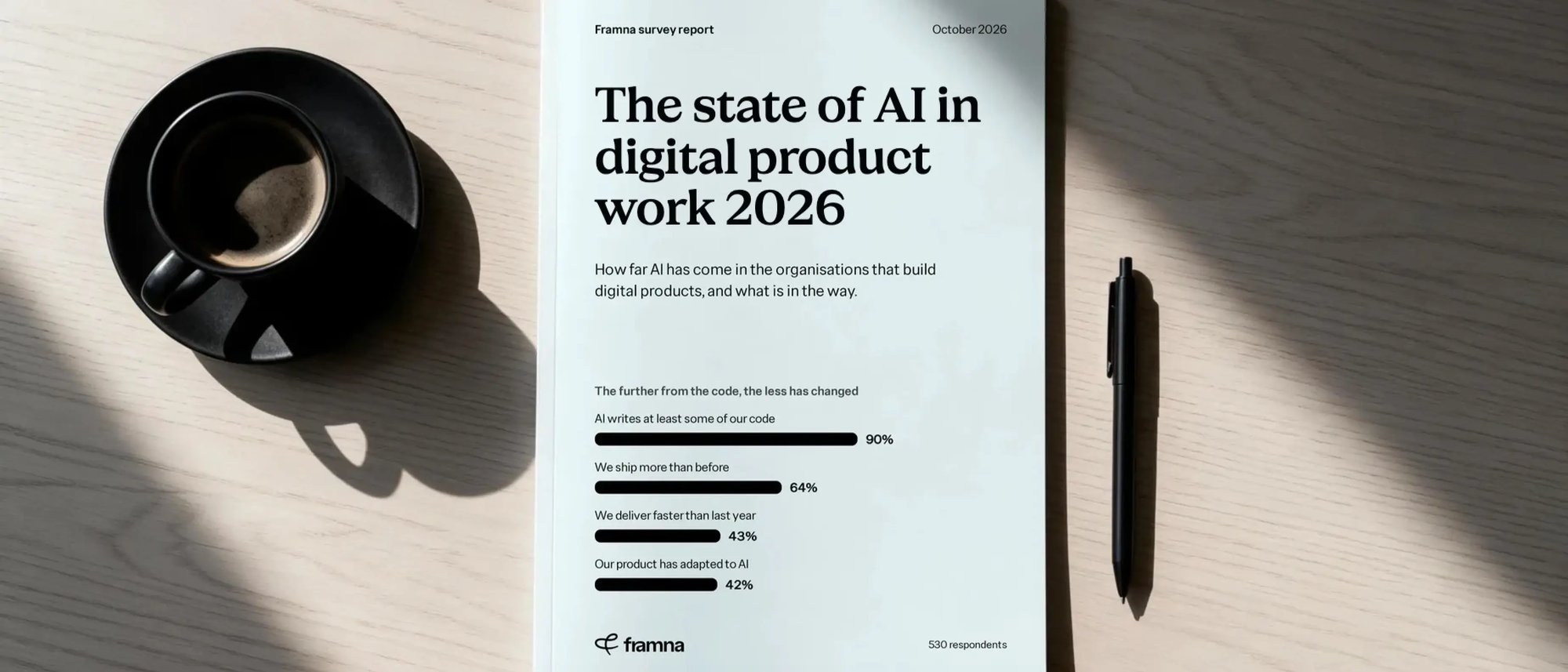
64% ship more than before. 43% deliver faster than a year ago.
03
The biggest brakes are rules, old systems, data and slow decisions, ahead of people’s skills.
49% name risk and compliance, 43% legacy systems, 34% data readiness and 33% the speed of decisions, against 26% skills and capacity.
04
Seven in ten are rethinking their product strategy, but only one in eight is done.
71% say AI is making them rethink it, 37% from the ground up. 13% say the rethink is largely done.
05
Next year’s plans point to personalization, which needs the very data and systems teams name as brakes.
45% plan to add personalized experiences, the most of any AI feature. Chat is the most common today, live for 43%.
Source: Framna, The leap to intelligent products, 2026. n=530.
How we read the answers
A product idea travels a route through an organization. It starts with what users need, becomes a decision about what to build, is built, and then has to reach the people it was built for. We built the survey along that route, and this report follows it. Then we look at what slows the route down, and at what organizations can and cannot yet see along it.
Most of the people who answered are designers (54%) and product leaders (18%), with engineers (10%), technology and executive leaders (5%) and other roles (12%) making up the rest. Two in three work in companies with more than 250 employees. Their answers are their own view of their work, not a measurement of it. See the full results here.
The question behind the survey
How far has AI traveled through the organizations that build digital products?
Where it starts: the user
We began where every product begins, with the people who use it. We asked how much AI has changed what users expect, and how far the product has kept up.
55% say AI has raised what their users expect, and 21% say it has raised it dramatically. 42% say their product has adapted. Since the same people answered both questions on the same scale, this is more than a gap between two averages: more than one in ten rate their users’ expectations higher than their own product’s response.
Don Norman, author of The Design of Everyday Things, described the mechanism when Framna’s CEO Joacim M. Jeppesen interviewed him in September: “When you use an app, you only have the choices that the app allows you to make.” As people get used to AI, he said, “if you offer them today’s apps, they will not like it.”
If users’ expectations have moved, plans should be moving too. We asked whether they are.
The decision: what to build next
71% say AI is making them rethink their product strategy, and 37% say from the ground up. Most are in the middle of it: 81% say the rethink is in progress, 13% that it is largely done.
The roadmap is changing direction. Today, the most common AI in products is conversational input, live for 43%: a way to ask the product something in your own words. The plans for the next twelve months point elsewhere. Personalized experiences (45%), insights and guidance (42%) and AI that carries out tasks for the user (39%) lead the list, with personalized experiences on top, though the three are close. All three require the product to know the person it is serving.
The steepest climb is in adaptive interfaces, which change with the person using them. 17% have one today and 35% plan to add one. If those plans are new and ship on time, the share would roughly triple within a year.
Plans become real when they become software, and that is where AI has gone furthest.
The build
90% say at least some of their code is now written with AI. 27% describe how their code is written as AI-assisted, 42% as a mix of people and AI, and 21% as agent-first: agents write the code, and people direct it and review what comes out. Only 5% still write everything by hand.
Output has risen too. 64% ship more than before, and 23% significantly more.
Engineering research shows the same thing. In Google’s DORA report for 2025, 90% of nearly 5,000 technology professionals used AI at work, and AI adoption was associated with higher delivery throughput but lower stability. In its words: “AI doesn’t fix a team; it amplifies what’s already there.”
More code, written faster, should mean users get new things sooner. So we asked how quickly ideas now reach them.
The road to the user
We asked two questions about delivery: how much faster people deliver than a year ago, and how long it takes to get an idea in front of users.
43% say they are faster than last year, against 4% who are slower. That is progress, but it is a smaller share than the 64% who ship more, and the arithmetic says at least one in five ship more without delivering any faster.
The lead times show how far there is still to go. 52% need a month or more from idea to user. 6% do it in days. Leave out the 21% who say it varies, and two in three of those who can name a lead time need a month or more.
Agent-first teams are a useful test. If any group reached users fastest, you would expect it to be the one where agents write the code. Agent-first respondents make up 21% of the sample, but only 6% of everyone reaches users in days. So at least two in three agent-first respondents cannot get an idea to users in days either: agents writing the code does not on its own shorten the road to users.
Studies that track engineering work directly show where the time goes. Faros AI analyzed telemetry from more than 10,000 developers across 1,255 teams. On teams with high AI adoption, developers merged 98% more pull requests, the time spent reviewing them rose 91%, and Faros found no significant improvement at company level.
If code is ready sooner and users still wait a month, the time is going somewhere between the two. We asked where.
What stands in the way
We asked what slows them down, and let people pick as many answers as applied. They pointed at the organization around the product more often than at the people building it. Risk and compliance (49%) and legacy systems (43%) come first. Data readiness (34%) and the speed of decision-making (33%) follow. Skills and capacity (26%), unclear value (23%) and culture (14%) come last.
Read the list in tiers, not as a strict order. Risk and compliance is named most often, but the six points to legacy systems are too few to separate them firmly in a sample like this. The 35 points between risk and culture are not.
Two things shape these answers. Most respondents work inside product teams, so this is largely the view from the team looking out. And in regulated industries, risk and compliance is a condition for shipping at all, and few would want it removed. One reading of the answers: approvals, systems and data set up for the pace at which code used to be written.
What organizations cannot yet see
Our last questions were about results: has quality changed, and where is the budget heading? A large share could not say.
One in five do not know whether the quality of what they ship has changed. One in five say their lead time varies, which may mean it is not tracked consistently. A third say it is too early to tell where their product budget is heading, or do not know. Where people did judge quality, better outnumbers worse by almost four to one, 30% against 8%, but “about the same” is still the most common answer.
The budget answers show where the pressure lands. 29% say their budget is growing because they can now build more. A third face higher expectations per euro: 26% have a flat budget with more expected of it, and 7% a shrinking one because AI is expected to make the work cheaper.
An organization that cannot say how long its ideas take to reach users, or whether its products got better, will find it hard to decide which of these obstacles to tackle first.
The route, put back together
Put the answers back in order along the route and a pattern appears. In our data, the share reporting change falls the further the question moves from the code.
This matters for the plans in chapter two. Conversational input, the AI most common in products today, can often sit on top of a product without touching the data, systems or approvals underneath. The AI that leads the plans usually cannot. Personalized experiences, interfaces that adapt and AI that acts for the user need customer data, connections to core systems and permission to act on someone’s behalf. Respondents name those areas most often as what slows them down. The survey does not link individual plans to individual brakes, but across the sample the overlap is clear.
What the findings add up to
The AI users expect next depends on the parts of the organization AI has changed least.
For Framna’s view of what organizations should do about it, read Joacim M. Jeppesen’s Customers have moved on. Most products haven’t.
What this survey cannot tell us
These results describe how 530 people see their own work. They do not measure delivery directly, and self-reported speed can differ from measured speed: in METR’s early-2025 trial, experienced developers believed AI had made them about 20% faster, while their measured completion times were 19% slower. The sample is self-selected, leans toward design and is unweighted, and some respondents may work for the same company. This edition does not split answers by role, company size or sector. The next one will, starting with lead time for agent-first teams against the rest.
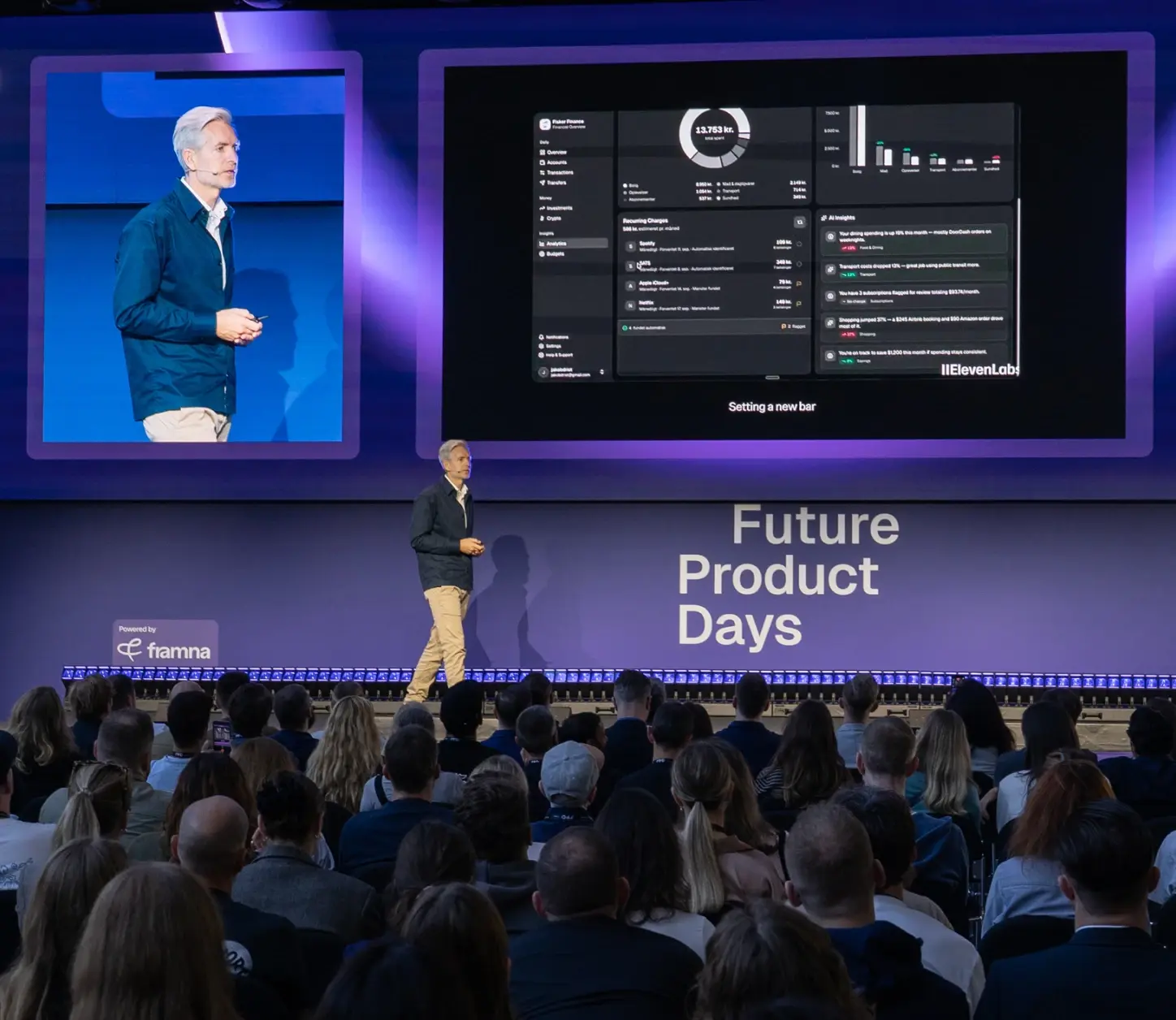
About the survey. The leap to intelligent products: AI in product work. Online questionnaire, September 2026, sent to participants at Future Product Days in Copenhagen and across Framna’s network. 530 respondents. Roles: product design 54%, product leadership 18%, product engineering 10%, technology leadership 3%, executive leadership 2%, other 12%. Company size: under 50 employees 12%, 50–250 21%, 250–1,000 21%, 1,000–5,000 22%, more than 5,000 23%. Self-selected and unweighted, so no margin of error is given; differences of a few points should be read as ties. Percentages are rounded and may not add to 100. Where several answers were possible, totals exceed 100%. On 1–5 scales, 4–5 is reported as agreement. See all results.
Sources. Google Cloud, DORA State of AI-assisted Software Development, 2025. Faros AI, The AI Productivity Paradox Report, 2025. METR, Measuring the Impact of Early-2025 AI on Experienced Open-Source Developer Productivity, 2025. Don Norman, interview with Framna, September 2026.
How to cite. Framna (2026). The leap to intelligent products: AI in product work. framna.com/insights. n=530.
About Framna. Framna designs, builds and runs digital products for companies where the product is business-critical. More than 500 people in Denmark, Sweden, the Netherlands, Poland and the US.
Our perspective on the shift
We share what we have learned from our own shift and from the companies we work with: where intelligent products create value, and what it takes to change how products are built and how decisions are made.
In a session with your leadership team, we present our point of view and go through what the findings mean for your organization.
More about AI in digital product work
Fresh perspectives from people who design, build and lead digital products
All Insights
All Insights
Subscribe
Join our newsletter and stay up-to-date